Adds first-class bot accounts (`UserTypeBot`): local, password-less
users for automation that authenticate only with access tokens.

1. Admin UI: create bots, filter users by type, manage a bot's access
tokens, convert between user and bot
2. API: `POST /admin/users/{username}/convert-type`, and user objects
gain a GitHub-compatible `type` (`User`, `Organization`, `Bot`)
3. CLI: `gitea admin user change-type`, `--user-type` accepts `User` or
`Bot` case-insensitively
4. Converting keeps the password, 2FA, OAuth2 grants and access tokens,
and since sign-in rejects bots, converting back restores the account.
Only local, non-admin accounts can be converted, and conversions are
audited
5. Session, reverse proxy, SSPI, external source and password reset
sign-in reject non-individual users, so a bot never gets an interactive
session
6. Bots receive no notifications or emails

Co-authored-by: Nicolas <bircni@icloud.com>
Co-authored-by: joestump <joe@joestump.net>
Co-authored-by: Joe Stump <joe@stu.mp>
Co-authored-by: silverwind <me@silverwind.io>
Co-authored-by: Lunny Xiao <xiaolunwen@gmail.com>
This PR closes remaining `public-only` token gaps in the API by making
the restriction apply consistently across repository, organization,
activity, notification, and authenticated `/api/v1/user/...` routes.

Previously, `public-only` tokens were still able to:
- receive private results from some list/search/self endpoints,
- access repository data through ID-based lookups,
- and reach several authenticated self routes that should remain
unavailable for public-only access.

This change treats `public-only` as a cross-cutting visibility boundary:
- list/search endpoints now filter private resources consistently,
- repository lookups enforce the same restriction even when addressed
indirectly,
- and self routes that inherently expose or mutate private account state
now reject `public-only` tokens.

---
Generated by a coding agent with Codex 5.2

---------

Co-authored-by: silverwind <me@silverwind.io>
Co-authored-by: Claude (Opus 4.7) <noreply@anthropic.com>
This PR changes the `opts` argument in `SearchUsers()` to be passed by
value instead of by pointer, as its mutations do not escape the function
scope and are not used elsewhere. This simplifies reasoning about the
function and avoids unnecessary pointer usage.

This insight emerged during an initial attempt to refactor
`RenderUserSearch()`, which currently intermixes multiple concerns.

Co-authored-by: Philip Peterson <philip-peterson@users.noreply.github.com>
just some refactoring bits towards replacing **util.OptionalBool** with
**optional.Option[bool]**

---------

Co-authored-by: KN4CK3R <admin@oldschoolhack.me>
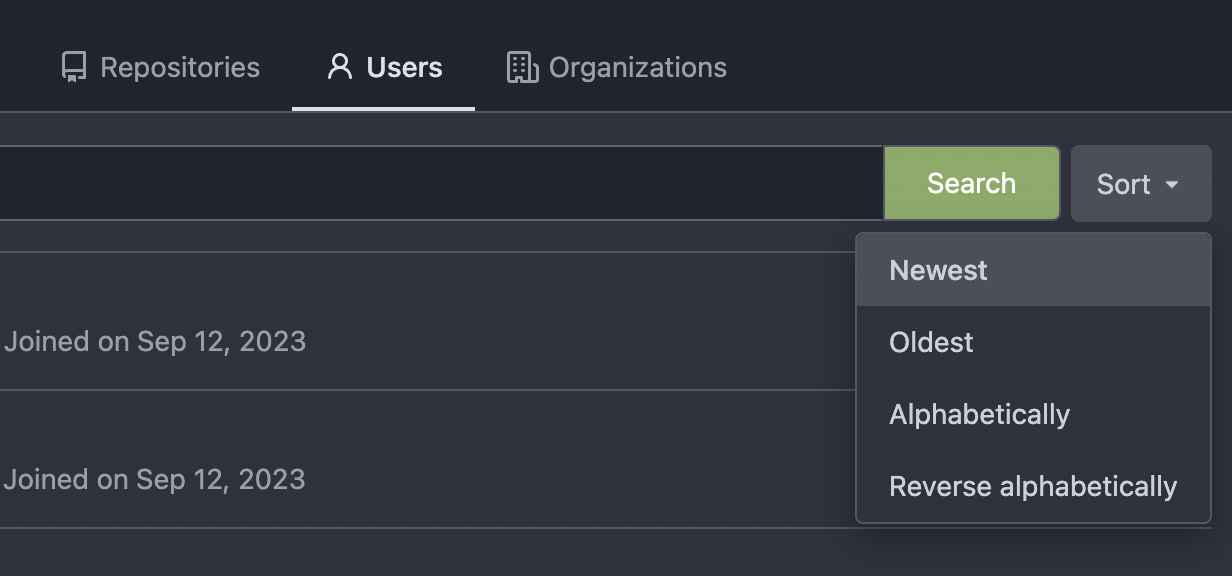
Thanks to inferenceus : some sort orders on the "explore/users" page
could list users by their lastlogintime/updatetime.
It leaks user's activity unintentionally. This PR makes that page only
use "supported" sort orders.
Removing the "sort orders" could also be a good solution, while IMO at
the moment keeping the "create time" and "name" orders is also fine, in
case some users would like to find a target user in the search result,
the "sort order" might help.
Part of #27065

This reduces the usage of `db.DefaultContext`. I think I've got enough
files for the first PR. When this is merged, I will continue working on
this.

Considering how many files this PR affect, I hope it won't take to long
to merge, so I don't end up in the merge conflict hell.

---------

Co-authored-by: wxiaoguang <wxiaoguang@gmail.com>
Change all license headers to comply with REUSE specification.
Fix#16132
Co-authored-by: flynnnnnnnnnn <flynnnnnnnnnn@github>
Co-authored-by: John Olheiser <john.olheiser@gmail.com>
Was looking into the visibility checks because I need them for something different and noticed the checks are more complicated than they have to be.

The rule is just: user/org is visible if
- The doer is a member of the org, regardless of the org visibility
- The doer is not restricted and the user/org is public or limited